
Why Mothers Keep Getting Triggered - Even When They Know Better
The real reason has nothing to do with patience.
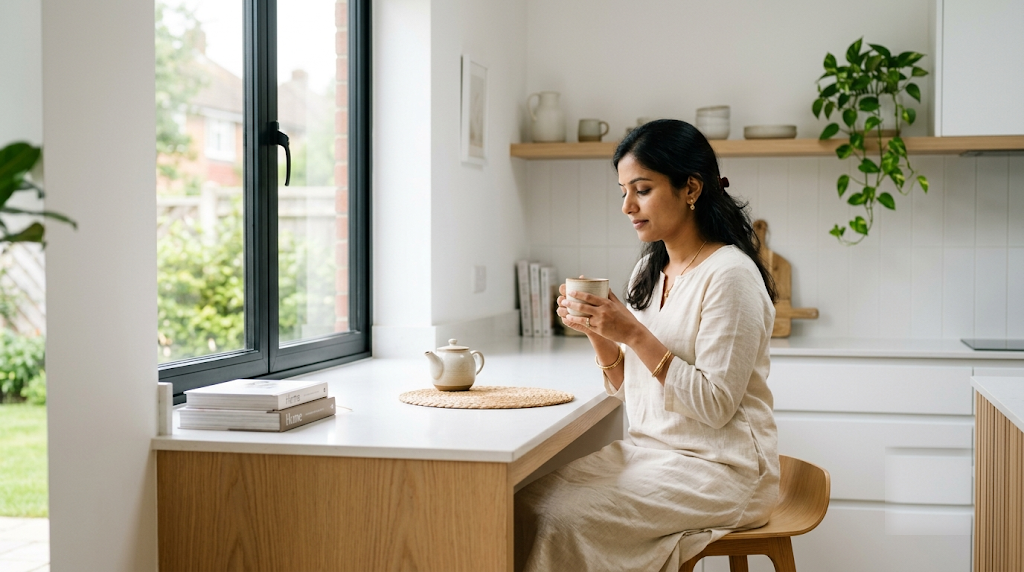
She has read the books. She follows the accounts. She knows - intellectually, completely - that shouting does not work. That snapping creates shame. That connection is the answer, not control.
And still. On an ordinary Tuesday, her son leaves his clothes on the floor for the fifteenth time, and she loses it.
The guilt comes immediately. The promise follows. "I will do better tomorrow."
Tomorrow comes. She is already running behind. Her daughter has done the exact thing she asked her not to do - again. And the reaction comes before she can stop it.
React. Guilt. Promise. Overwhelm. React. Guilt. Promise.
If you recognise this loop, I want you to know something before we go any further: there is nothing wrong with you. You are not failing at conscious parenting. You are a mother whose cup has been empty for a long time - and nobody told you that was the real problem.
The problem is not your patience. It is your load.
Here is what most parenting content gets wrong: it treats triggers as a knowledge problem. "Just be patient." "Breathe before you react." "Remember your child's brain is still developing."
These are not bad suggestions. But they are incomplete. Because they assume the mother applying them has the internal space to do so. And most mothers today do not.
Think about what a mother carries in a single day. Her career. Her home. Her children's emotional worlds. The mental load of remembering everything for everyone. The invisible labour that never makes it onto any to-do list. The clock that is always ticking, and the list that never ends.
When a nervous system is running at full capacity - when the cup is genuinely empty - patience is not a choice you can make in the moment. It is a resource you have already spent.
The trigger is almost never really about the clothes on the floor. It is about the hundred things that came before the clothes on the floor.
Why tools and techniques are not enough on their own
Tools work. But only when you know what problem you are solving.
Right now, most mothers are collecting tools without awareness. They read about co-regulation but have never paused to understand what dysregulates them. They learn about emotional validation but have never identified what emotions they themselves are suppressing. They absorb technique after technique - and then wonder why nothing changes when the real moment arrives.
Awareness is what makes a tool usable. Without it, you are trying to fix something you have not yet fully seen.
And what does awareness actually mean here? It means knowing what is happening inside you before the trigger fires. It means recognising when your expectations of your children are too high for the moment you are in. It means seeing the perfection-driven part of yourself that takes on everything, refuses to delegate, and then collapses under the weight of it all.
Awareness is not another tool. It is the foundation under every tool.
The loop that keeps her stuck
The react-guilt-promise cycle is not a discipline problem. It is a structural one.
She reacts because she is overwhelmed. She feels guilty because she knows better. She promises because she genuinely wants to change. And then the next day arrives - with the same load, the same pace, the same empty cup - and the cycle begins again.
What breaks the loop is not a stronger promise. It is a different relationship with what she is carrying.
That means getting honest about what is on her plate. Letting go of the belief that she has to carry all of it. Delegating what does not need her energy. Creating actual space - not stolen moments between tasks, but real, protected space for her own emotional and mental health.
And it means understanding something our previous generations understood instinctively: no mother was ever meant to do this alone.
What mothers have lost - and urgently need back
There is a reason previous generations of mothers seemed steadier - not because they were more patient, but because they were less isolated. There were grandparents, neighbours, extended family, elders. There was always someone to hand the child to. Always someone to sit beside you and say "I know. Me too."
Today's mother is parenting in a nuclear family, often without that village. The load lands entirely on her shoulders. And with no outlet for the emotions she is holding, no space to be honest about what she is going through, the pressure builds - until a small trigger releases all of it at once.
Community is not a nice-to-have. It is a nervous system regulation tool. Being witnessed, being heard, being in the energy of other mothers who are walking the same path - this is what fills the cup. This is what creates the internal space that makes awareness possible.
When you are around people who lift you, who challenge you gently, who remind you that you are not alone - you do not need as much patience. Because you are not running on empty anymore.
So what actually helps?
Not more content. Not another parenting book. Not a new technique.
What actually helps is this:
Awareness of what is happening inside you. Not just in the moment of the trigger, but in the hours and days leading up to it. What was building? What were you holding? What need of yours was going unmet?
Honest assessment of your load. What on your plate genuinely needs you - and what could be shared, delegated, or released? Overwhelm is not a character trait. It is a signal that something needs to change structurally.
A community that holds you. Not to vent endlessly, but to grow together. To be around mothers who are also doing the work - so that the work becomes part of your daily energy, not something you do alone in isolated moments.
Permission to be human. Sometimes you will still snap. Sometimes the cycle will catch you before you catch yourself. That is not failure. That is the process. What matters is that you are aware, you are trying, and you are not doing it alone.
You do not need to be a perfect mother. You need to be a mother who knows herself - who understands what fills her and what drains her, who asks for help before she breaks, and who has a space where she is truly seen.
That is what breaks the loop. Not willpower. Awareness and community.
Ready to stop going around in circles?
Every Sunday, I run a live webinar where we go deep into exactly this - reconnecting with yourself, reconnecting with your child, and rebuilding the foundation that makes conscious parenting sustainable. Not just on good days. Every day.
It is not another space where you will collect more tools. It is a space where you will finally understand what has been getting in the way of using the ones you already have.